- +8801551061245
- info@maxviewgroup.com
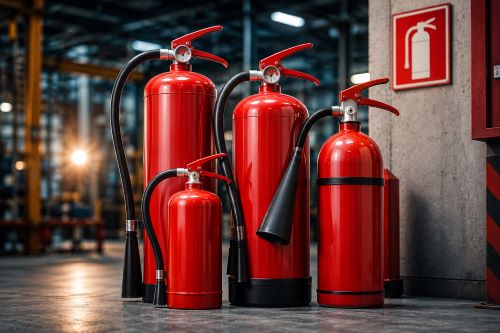
A fire extinguisher is an active fire protection device used to extinguish or control small fires, often in emergencies. It is not intended for use on an out-of-control fire, such as one which has reached the ceiling, endangers the user (i.e., no escape route, smoke, explosion hazard, etc.), or otherwise requires the equipment, personnel, resources, es and/or expertise of a fire brigade. Typically, a fire extinguisher consists of a hand-held cylindrical pressure vessel containing an agent that can be discharged to extinguish a fire. Fire extinguishers manufactured with non-cylindrical pressure vessels also exist but are less common.

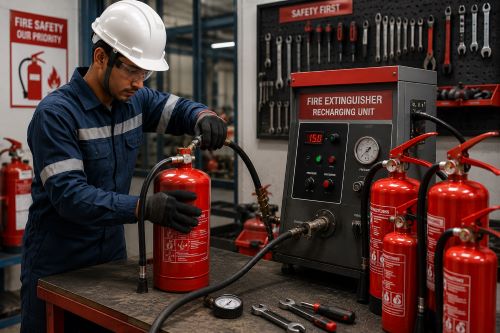
There are two main types of fire extinguishers: stored-pressure and cartridge-operated. In stored pressure units, the expellant is stored in the same chamber as the firefighting agent itself. Depending on the agent used, different propellants are used. With dry chemical extinguishers, nitrogen is typically used; water and foam extinguishers typically use air. Stored pressure fire extinguishers are the most common type. Cartridge-operated extinguishers contain the expellant gas in a separate cartridge that is punctured before discharge, exposing the propellant to the extinguishing agent. This type is not as common, used primarily in areas such as industrial facilities, where they receive higher-than-average use. They have the advantage of simple and prompt recharge, allowing an operator to discharge the extinguisher, recharge it, and return to the fire in a reasonable amount of time. Unlike stored pressure types, these extinguishers use compressed carbon dioxide instead of nitrogen, although nitrogen cartridges are used on low-temperature (–60 rated) models. Cartridge-operated extinguishers are available in dry chemical and dry powder types in the U.S. and water, wetting agent, foam, dry chemical (classes ABC and B.C.), and dry powder (class D) types in the rest of the world.
Fire extinguishers are further divided into handheld and cart-mounted (also called wheeled extinguishers). Handheld extinguishers weigh from 0.5 to 14 kilograms (1.1 to 30.9 lb), and are hence, easily portable by hand. Cart-mounted units typically weigh more than 23 kilograms (51 lb). These wheeled models are most commonly found at construction sites, airport runways, heliports, as well as docks and marinas.
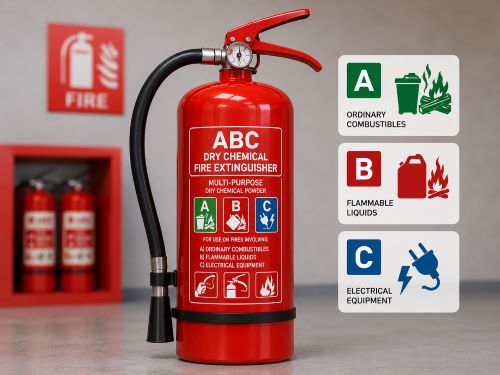
| Fire class | Geometric symbol | Pictogram | Intended use | Mnemonic | |
|---|---|---|---|---|---|
| A | Ordinary solid combustibles | A for “Ash” | |||
| B | Flammable liquids and gases | B for “Barrel” | |||
| C | Energized electrical equipment | C for “Current” | |||
| D | Combustible metals | D for “Dynamite” | |||
| K | Oils and fats | K for “Kitchen” | |||
Fire extinguishing capacity is rated in accordance with ANSI/UL 711: Rating and Fire Testing of Fire Extinguishers. The ratings are described using numbers preceding the class letter, such as 1-A:10-B:C. The number preceding the A multiplied by 1.25 gives the equivalent extinguishing capability in gallons of water. The number preceding the B indicates the size of fire in square feet that an ordinary user should be able to extinguish. There is no additional rating for class C, as it only indicates that the extinguishing agent will not conduct electricity, and an extinguisher will never have a rating of just C.
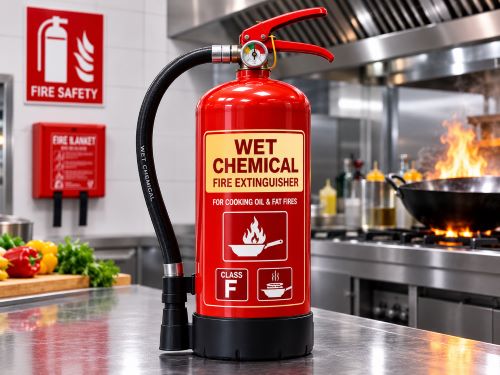
Wet chemical (potassium acetate, potassium carbonate, or potassium citrate) extinguishes the fire by forming an air-excluding soapy foam blanket over the burning oil through the chemical process of saponification (a base reacting with a fat to form a soap) and by the water content cooling the oil below its ignition temperature. Generally, class A and K (F in Europe) only, although older models also achieved class B and C fire-fighting capability in the past, current models are rated A:K (Amerex, Ansul, Buckeye and Strike First) or K only (Badger/Kidde).
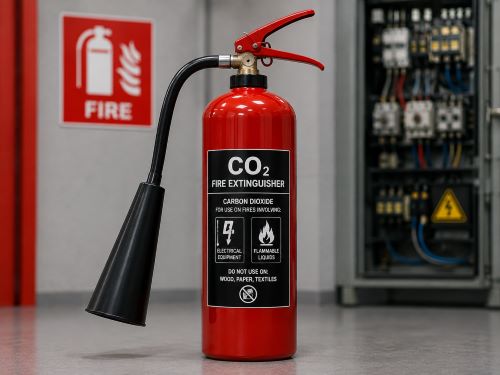
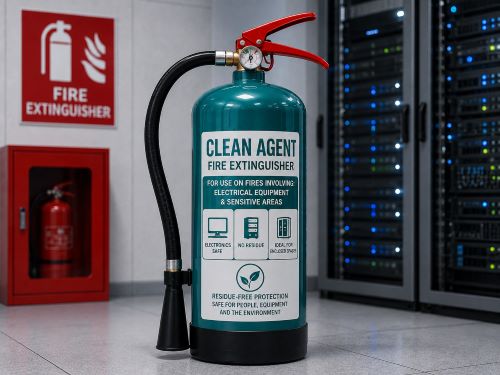
Clean agents extinguish fire by displacing oxygen (CO2 or inert gases), removing heat from the combustion zone (Halotron I, FE-36, Novec 1230) or inhibiting the chemical chain reaction (Halons, Halotron BrX). They are referred to as clean agents because they do not leave any residue after discharge, which is ideal for protecting sensitive electronics, aircraft, armored vehicles and archival storage, museums, and valuable documents.
Halon was completely banned in Europe and Australia except for critical users like law enforcement and aviation, resulting in stockpiles either being destroyed via high heat incineration or being sent to the United States for reuse. Halon 1301 and 1211 are being replaced with new halocarbon agents which have no ozone depletion properties and low atmospheric lifetimes, but are less effective. Halon 2402 is a liquid agent (dibromotetrafluoroethane) which has had limited use in the West due to its higher toxicity than 1211 or 1301. It is widely used in Russia and parts of Asia, and it was used by Kidde‘s Italian branch, marketed under the name “Fluobrene”.
There are several class D fire extinguisher agents available; some will handle multiple types of metals, others will not.
TMB was used experimentally by the US Air Force, specifically with regard to B-52 engine assemblies, and was tested in modified 10-gallon wheeled CBM extinguishers. Other agents were added to suppress the methanol flare up, such as chlorobromomethane (CBM), Halon 2402, and Halon 1211, with varied success. Halon 1211 was the most successful, and the combined TMB pressurized with halon 1211 and nitrogen was called Boralon was used experimentally by the Los Alamos National Laboratory for use on atomic metals, using sealed cylinder extinguishers made by Metalcraft and Graviner which eliminated the moisture contamination problem. TMB/Boralon was abandoned in favor of more versatile agents, though it is still mentioned in most US firefighting literature.[35]
Buffalo marketed a 2.5-gallon and 1-quart extinguisher using M-X liquid discharged through a low-velocity shower head-type nozzle, but it was met with limited success, as it was going up against Ansul’s Met-L-X, which could be used on more types of metals and was non-combustible. M-X had the advantage of being easy to recharge and non-corrosive since it was oil-based, but production did not last long due to its limited applications.
Most class D extinguishers will have a special low-velocity nozzle or discharge wand to gently apply the agent in large volumes to avoid disrupting any finely divided burning materials. Agents are also available in bulk and can be applied with a scoop or shovel.
Several modern “ball” or grenade-style extinguishers are available on the market. The modern version of the ball is a hard foam shell, wrapped in fuses that lead to a small black powder charge within. The ball bursts shortly after contact with flame, dispersing a cloud of ABC dry chemical powder which extinguishes the fire. The coverage area is about 5 m2 (54 sq ft). One benefit of this type is that it may be used for passive suppression. The ball can be placed in a fire-prone area and will deploy automatically if a fire develops, being triggered by heat. They may also be manually operated by rolling or tossing into a fire. Most modern extinguishers of this type are designed to make a loud noise upon deployment.[39]
This technology is not new, however. From about 1880 glass “fire grenades” filled with a weak solution of common salt and ammonium chloride in water were popular. The addition of the salts was to prevent freezing, with ammonium chloride thought to be more effective in extinguishing flame. They were deployed by hurling them at the base of the fire. Containing only about one imperial pint (0.57 l) they were of limited use. Some later brands, such as Red Comet, were designed for passive operation and included a special holder with a spring-loaded trigger that would break the glass ball when a fusible link melted, or were sealed with wax to melt in contact with flame and release the contents. As was typical of this era, some glass extinguishers contained the toxic (but effective) carbon tetrachloride. These glass fire grenade bottles are sought by collectors.[40][41]
Condensed aerosol fire suppression is a particle-based form of fire extinction similar to gaseous fire suppression or dry chemical fire extinction. As with gaseous fire suppressants, condensed aerosol suppressants use clean agents to suppress the fire. The agent can be delivered by means of mechanical operation, electric operation, or combined electro-mechanical operation. To the difference of gaseous suppressants, which emit only gas, and dry chemical extinguishers, which release powder-like particles of a large size (25–150 µm) condensed aerosols are defined by the National Fire Protection Association as releasing finely divided solid particles (generally <10 µm), usually in addition to gas.[42]
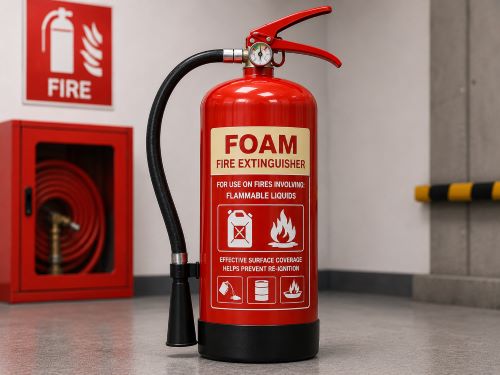
Whereas dry chemical systems must be directly aimed at the flame, condensed aerosols are flooding agents and therefore effective regardless of the location and height of the fire. Wet chemical systems, such as the kind generally found in foam extinguishers, must, similarly to dry chemical systems, be sprayed directionally, onto the fire. Additionally, wet chemicals (such as potassium carbonate) are dissolved in water, whereas the agents used in condensed aerosols are microscopic solids.
In 2015, researchers from George Mason University announced that high volume sound with low bass frequencies in the 30 to 60 hertz range drives oxygen away from the combustion surface, extinguishing the fire, a principle was previously tested by the Defense Advanced Research Projects Agency (DARPA).[43] One proposed application is to extinguish fires in outer space, with none of the clean-up required for mass-based systems.[44]
Another proposed solution for fire extinguishers in space is a vacuum cleaner that extracts the combustible materials.[45]
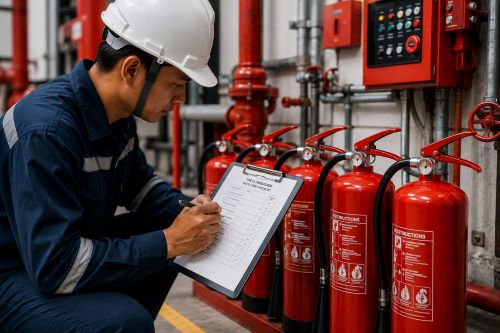
Most countries in the world require regular fire extinguisher maintenance by a competent person to operate safely and effectively, as part of fire safety legislation. Lack of maintenance can lead to an extinguisher not discharging when required, or rupturing when pressurized. Deaths have occurred, even in recent times, from corroded extinguishers exploding.
In the United States, state and local fire codes, as well as those established by federal agencies such as the Occupational Safety and Health Administration, are generally consistent with standards established by the National Fire Protection Association (NFPA).[46] They commonly require, for fire extinguishers in all buildings other than single-family dwellings, inspections every 30 days to ensure the unit is pressurized and unobstructed (done by an employee of the facility) and an annual inspection and service by a qualified technician. Some jurisdictions require more frequent service. The servicer places a tag on the extinguisher to indicate the type of service performed (annual inspection, recharge, new fire extinguisher). Hydrostatic pressure testing for all types of extinguishers is also required, generally every five years for water and CO2 models up to every 12 years for dry chemical models.
Recently the NFPA and ICC voted to allow for the elimination of the 30-day inspection requirement so long as the fire extinguisher is monitored electronically. According to NFPA, the system must provide record keeping in the form of an electronic event log at the control panel. The system must also constantly monitor an extinguisher’s physical presence, internal pressure and whether an obstruction exists that could prevent ready access. In the event that any of the above conditions are found, the system must send an alert to officials so they can immediately rectify the situation. Electronic monitoring can be wired or wireless.
In the UK, three types of maintenance are required:
Maxview Group have Industrial, Agricultural & Non-Agricultural Process Industries.Manufacture,Internationally Show rooms handles ready-made Orion, EXPORT-IMPORT,Oxide-base productions, Auto Bricks & Ceramic, Bleaching powder chemical Industry, Fair-Exigulastion to negotiate the best terms.
http://max.test/m-s-dullil-uddin-traders-ltd/