- +8801551061245
- info@maxviewgroup.com
The bleaching agents in food product allows the lightening of the food color. The bleaching agent is mainly used in dairy processed products, bakery, and oil manufacturing.
Calcium hypochlorite can be defined as a chemical compound having the formula Ca(ClO)2.
Commonly, it is referred to as either calcium oxychloride or bleaching powder. It can be said as an ionic compound, made up of two hypochlorite anions (ClO–) and a calcium cation (Ca2+). Despite being stable at room temperatures, calcium hypochlorite decomposes slowly in moist environments, giving it a characteristic ‘chlorine’ smell. The common name of calcium hypochlorite can be given as bleaching powder.
Calcium hypochlorite is a compound known to be an active ingredient in most commercial bleaching agents such as chlorinated lime and chlorine powder bleaching powder.
(image will be uploaded soon)
Commercially, calcium hypochlorite is available in its hydrated and anhydrous forms and is one of the primary ingredients of both bleaching powder and chlorine powder. The Ca(ClO)2 compound is produced on an industrial scale through the chlorine gas reaction with calcium hydroxide.
The chemical equation representation for this reaction can be given as follows.
2Ca(OH)2 + 2Cl2 → Ca(ClO)2 + H2O + CaCl2
In general, the bleaching powder is a calcium hypochlorite mixture, and its dibasic form can be given as (Ca(ClO2).2Ca(OH)2). In contrast, the dibasic form of calcium chloride can be given as (CaCl2.2Ca(OH)2). Because it contains two ClO– ions, this compound contains a high chlorine availability to that of sodium hypochlorite (NaOCl).
The Ca(ClO)2 molecule’s structure consists of one Ca+ ion and two ClO– ions. The representation can be given as follows.
(image will be uploaded soon)
Each chlorite ion holds a -1 charge, whereas the calcium ion holds a +2 charge. Thus, one calcium cation can form ionic bonds with the help of two hypochlorite ions.
Calcium hypochlorite is a compound that is industrially produced by treating lime (Ca(OH)2) with chlorine gas. This reaction is conducted in stages to produce various compositions, each with a different calcium hypochlorite concentration, together with the unconverted calcium chloride and lime. The chemical representation can be shown as,
2 Cl2 + 2 Ca(OH)2 → Ca(CIO)2 + CaCl2 + 2 H2O
Bleaching powder is prepared with a moist slaked lime slightly. It is also not a simple mixture of calcium chloride, calcium hydroxide, and calcium hypochlorite. However, instead, it is a mixture that principally contains the dibasic calcium hypochlorite, calcium hypochlorite Ca(ClO)2, Ca3(ClO)2(OH)4 (can also be written as Ca(ClO)2 · 2 Ca(OH)2), and the dibasic calcium chloride, Ca3Cl2(OH)4 (calcium hydroxy chloride, which is also written as CaCl2 · 2 Ca(OH)2).
The Ca(ClO)2 compound is often used to disinfect large volumes of water by making it safe to drink. It can also be used widely in swimming pools to sanitize water bodies and destroy the germs present in it. A few other primary calcium hypochlorite uses are listed below.
Read More at:-
https://www.fortunebusinessinsights.com/food-bleaching-agents-market-102439
Maxview Bleaching Powder Industry Ltd.
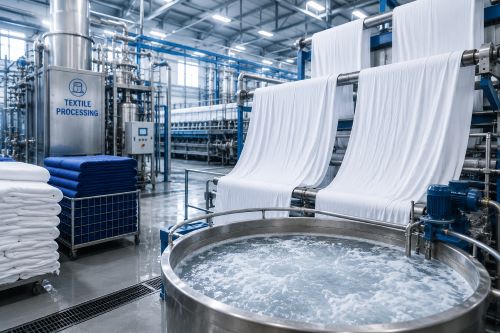
Bleaching is an important and essential step in pretreatment of Textiles. It helps ‘whiten’ the textile material by removing undesired inherent coloring components. Generally, the natural fibres and their blends comprise about 50 % of total textile substrates and are invariably bleached, while the regenerated and synthetic goods are given this treatment considering the specific requirement. Depending on the substrate, a number of chemicals and application methods are employed to achieve optimum bleaching effect, however, it is also imperative to remove and get rid of the excess and leftover bleaching agent from the textile goods before subsequent wet processing. In this article an attempt is made to review various bleaching chemicals used in textile industry and the methods of their removal and cleaning.
Inherent colorants in textile
Natural vegetable fibers like cotton, linen, jute, etc. contain varying extent of pigments like Chlorophyll, Xanthophyll and Carotene. This imparts off-white, yellowish brown hue and depends on the area of cultivation, climatic conditions and varies from crop to crop. Similarly, the animal fibers like wool and silk too contain non protein impurities which impart characteristic color.
Need of Bleaching
Bleaching is the process of decolorization of raw textile material by removing inherent and or acquired coloring components from the fiber. It provides base whiteness to the textile material which could be further whitened with the help of optical brighteners or dyed | printed depending on the desired end use. Even in case of regenerated and synthetic fibers, bleaching step is incorporated for achieving full white or extra bright shades. Though, in case of material to be dyed with dark and dull shades bleaching step could be omitted.
Bleaching can be carried out at various stages of conversion of fiber to garment i.e. from fiber, yarn, hank, woven, knit, towel, sewn up garments, etc. on various types of machines by simple hand processing to sophisticated bleaching ranges and by different application processes from exhaust to continuous.
Bleaching chemicals
Though bleaching is an age old process, the major commercial chemicals were developed in the last few centuries. The modern bleaches resulted from the work of 18th century scientists Claude Berthollet, who developed bleaching with sodium hypochlorite, later Louis Thnard produced hydrogen peroxide which gained wide commercial acceptance.
Basically, two type of chemical processes are employed – oxidative and reductive, and are employed depending on the substrate to be bleached and the nature of inherent coloring impurities.
The organic compounds containing conjugated double bonds are considered to be the color producing agents in natural fibers. Their decoloration can occur by breaking up the chromophore, most likely by destroying one or more of the double bonds within the conjugated system and by breaking up the resonance.
In case of oxidative bleaching, Chlorine is the basis for commonly used bleaching agents like sodium hypochlorite, bleaching powder and sodium chlorite. While, the non chlorine containing oxidative chemicals are hydrogen peroxide, sodium persulphate, sodium percarbonate, sodium perborate and peracetic acid. Sometimes peroxide bleaches are also used along with catalysts and activators like tetra acetyl ethylene diamine (TAED) and sodium nonanoyloxy benzene sulfonate (SNOBS). The reducing agent based bleaching agents comprise of sodium dithionite or sodium hydrosulfite, sodium thiosulphate and sulfinic acid derivatives.
The commonly used application methods are:
The oxidative chemicals are widely used for bleaching of natural fibers like cotton, linen, jute, wool, while reductive method is used for Polyamide and Polyacrylates. The chlorine based bleaches though economical and easy to apply have lost importance due to health and environmental issues but still find use in some areas.
The selection of bleaching agent depends on the fiber and machinery in use, the method of application, the extent of whiteness expected without adversely impacting fiber strength and meeting the desired cost economics.
Hydrogen peroxide is the most common and universally used bleaching agent and is applied under specified conditions of time, temp, pH and stabilizers for optimum efficacy. The generally considered advantages in its use are:
Need for bleach clean up
Generally, the peroxide bleaching process is set in such a way that it retains about 10-15% of the initial peroxide amount at the end. This is achieved by optimising the process parameters and incorporating suitable stabilisers. The basic purpose is to avoid uncontrolled and rapid decomposition of strong oxidising agent which is detrimental to the tensile strength of cellulosic textiles. Similarly, in case of other bleaching agents, in order to achieve optimum results, slight excess is used at the start which is carried forward as residue at the end.
When the textile material is to be dyed after bleaching, it becomes imperative that the left over | residual bleaching agent is effectively removed, as the bleaching agent affects coloring component |chromophore of dyestuff. Failure to do so can result in poor dyeability, batch-to-batch shade reproducibility as well as uneven dyeing. Therefore, in order to get rid of the remaining leftover bleaching agent a intermittent bleach clean-up process is incorporated before dyeing. It is also termed as peroxide killing or neutralisation in case of hydrogen peroxide and antichlor in case of chlorine based bleaching. This is specifically required in processes involving use of material in package or rope form, while in continuous process, owing to the open width form and continuous counter current water washing, generally bleach clean-up is not required.
Even in case of full bleach or full white process, where high concentration of bleaching agent is used it is considered advantageous to neutralise and clean-up to avoid subsequent yellowing during extended storage conditions.
The Direct and Reactive dyestuffs are generally sensitive to oxidizing agents and even small amount of post bleaching residual hydrogen peroxide may have a negative influence on subsequent dyeing resulting in loss of depth. The Vat and Sulphur dyes are relatively stable and unaffected by the residual bleaching chemical, however, it is still considered advisable to clean-up the strong oxidizing agent before start of dyeing in order to avoid neutralization of dye solubilising chemicals which could cause inadequate reduction |precipitation of this class of dyestuffs.
Given below is an illustration on dyeability and effect on color strength of select high exhaust bis-monochlorotriazine type Reactive dyes -with and without bleach clean-up.
Methods of Beach Clean-up
Various methods of bleach clean-up are employed in the textile industry. These involve – repetitive washing, catalytic decomposition, reductive neutralisation and enzymatic killing.
Given below is one representative process along with general recommended chemicals for bleaching of cotton knit material by exhaust application in soft flow machine, prepared for subsequent dyeing with Reactive dyes.
Given below is an example of effect of varying amount of residual bleaching agent on color value of a medium black shade developed with a recipe of a combination of bi-functional reactive dyes.
No Residual Peroxide in bath | 5 mg |l H2O2 in bath | 25 mg |l H2O2 in bath | |
Rel Depth 89% | Rel Depth 76% | ||
Without Bleach Clean-up | |||
With RUCORIT INPK | |||
Catalase
2H2O2 2H2O + O2
The Enzyme is a bio catalyst produced by fermentation of microorganisms, acts very specifically on hydrogen peroxide and increases reaction speed by lowering the activating energy without any harmful side effects. Enzymes present a more convenient alternative because they are easier and quicker to use. With the increasingly important requirement for textile manufacturers to reduce pollution during production, the use of enzymes is rapidly gaining wider recognition because of their non-toxic and eco-friendly characteristics. The advantages of Enzymatic treatment over other methods are:
Complete and quick elimination of residual hydrogen peroxide
Given below is a schematic process flow of cotton yarn preparation regularly running at a leading textile unit in India.
Assessment of bleach clean-up
To ensure effectiveness and efficiency of removal of residual bleaching agent, it is necessary to evaluate the same and various quantitative and qualitative methods of assessment are
Summary
Consistent bleach clean up is key to even dyeing and shade reproducibility.
The removal of residual bleaching agent is an important step to ensure uniform, level dyeing and obtaining the highest final depth of shade. Bleach clean-up is very important when cotton substrate is to be dyed with bleach sensitive dyes, such as direct and reactive dyes.
References
Maxview Group have Industrial, Agricultural & Non-Agricultural Process Industries. Manufacturer,Internationally Show Rooms handles Ready-Made Orion, Export-Import,Oxide-Base Productions, Auto Bricks & Ceramic, Bleaching Powder Chemical Industry, Fair-Exgulaiser to negotiate the best terms.
http://max.test http://max.test/business-profile/ http://max.test/hiv-aids-study/ http://max.test/injury-prevention/


Maxview Group have Industrial, Agricultural & Non-Agricultural Process Industries. Manufacturer,Internationally Show Rooms handles Ready-Made Orion, Export-Import,Oxide-Base Productions, Auto Bricks & Ceramic, Bleaching Powder Chemical Industry, Fair-Exgulaiser to negotiate the best terms.
http://max.test http://max.test/business-profile/ http://max.test/hiv-aids-study/ http://max.test/injury-prevention/
© 2022 Maxview Group & Non profitable organozation Right Resived | Developed by Branex IT